 betterflo
Nothing is sent by default
Audio and text are processed on-device. By default there’s no upload of what you say or type — and no request for anyone to inspect.
Betterflo turns your speech into text on the device in your hand — by default, with no server in the loop. On-device isn't a privacy toggle you remember to switch on. It's the only thing the architecture can do.
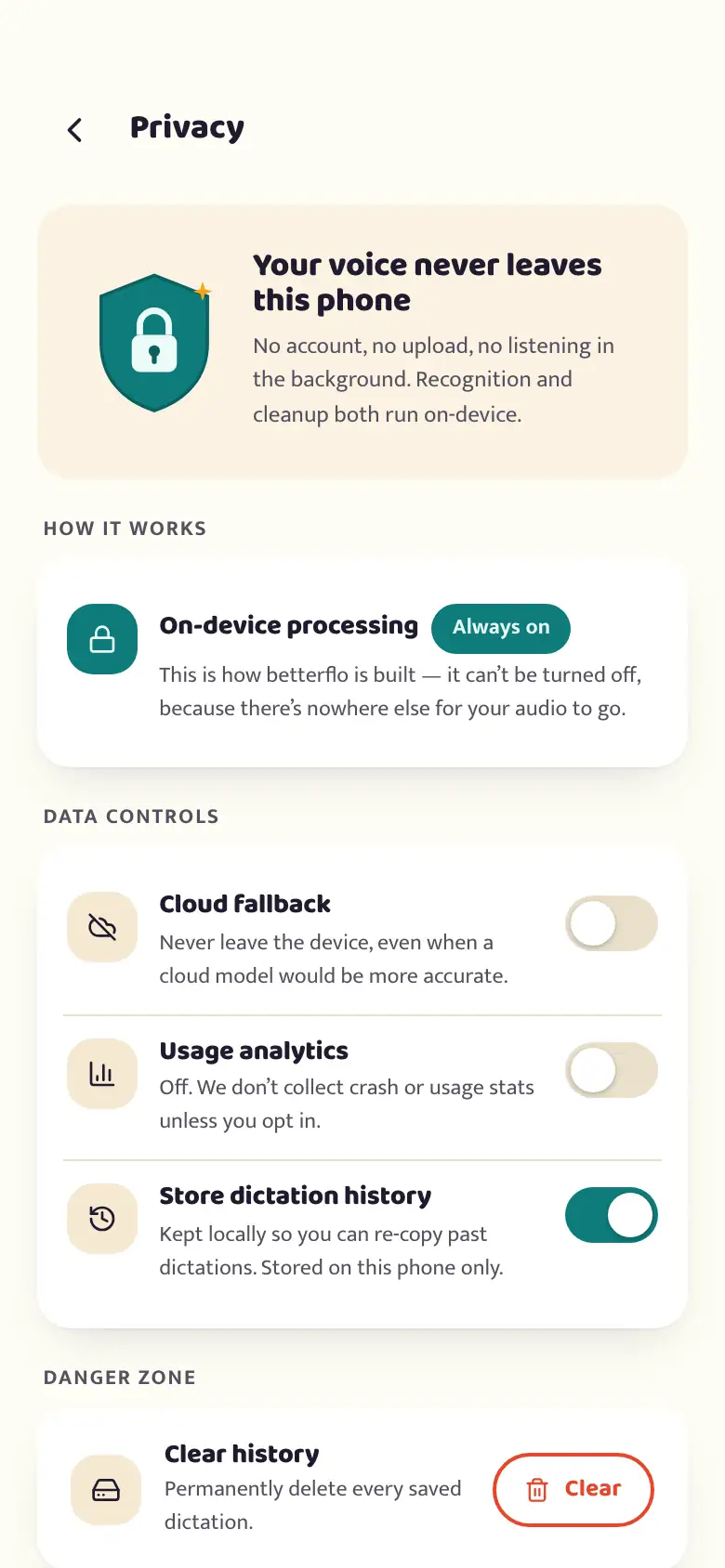
A promise can be broken; an architecture can’t exceed what it’s built to do. Betterflo keeps your words on the device for four reasons that hold whether or not you believe us.

Audio and text are processed on-device. By default there’s no upload of what you say or type — and no request for anyone to inspect.
On a flight, in a basement, on a dead 2G cell — dictation still runs. The on-device tier never needs a connection to do its job.
There’s no server in the path, so there’s no server to go down. Your dictation doesn’t depend on our uptime, our funding, or our bad days.
On-device compute costs us almost nothing per user — so there’s no business reason to harvest, store, or sell what you say. The incentive to keep your data simply isn’t there.
Read the label: “by default.” A Pro tier will add an optional cloud-quality mode — you’d turn it on knowing exactly what leaves the device. Everything above describes betterflo out of the box, and the free, on-device tier stays that way. We say “by default,” not “never,” because that’s the true version.
One more thing “on-device” doesn’t mean. The floating mic inserts text using an Android accessibility service, so — while you’re dictating — betterflo reads the field you’re focused on, locally, to put your words in it. That’s a real capability, not a hidden one: it changes what betterflo can read on your phone, not what it sends, which is still nothing. See exactly what it can see
When dictation has to round-trip through a server, some risks aren’t bugs — they’re the design. Same job, two architectures.
| Cloud-mandatory design | betterflo | |
|---|---|---|
| Where your voice goes | Uploaded to a server | Stays on your phone by default |
| With no internet | Dictation stops | Works fully offline |
| If the server goes down | So does your keyboard | Nothing in the path to fail |
| What can be logged | Content may be retained | No telemetry of what you say |
| Cost to run you | A per-word server bill | ~₹0 on-device |
| Reason to keep your data | Built into the model | None — there’s nowhere for it to go |
If a dictation app has to send your voice to a server to work, then one rushed feature, one bad quarter, one breach is all it takes. Betterflo has no server in that path. There is nothing to screenshot to, nothing to over-collect with, nothing to leak — whatever the app reads on your phone to do its job, it has nowhere off the phone to send it.
We didn’t promise not to. We built it so we can’t.
Read exactly what we do and don’t collectFree to start, no account, works offline from the first tap. You’ll turn on the floating mic after install — it’s quick, and we walk you through what it needs and why.

 Scan to install